Important Information
This content is provided for informational purposes and does not constitute medical advice. Consult a qualified orthopaedic surgeon for any decision regarding knee surgery.
Surgery is not always the answer. Neither is waiting indefinitely. This guide examines the clinical indicators that suggest surgery may be appropriate, the conservative options worth exhausting first, and the practical questions that shape a productive surgical consultation.
In This Article
Signs Your Knee Condition May Require Surgical Intervention
Two hundred and forty million people worldwide live with symptomatic, activity-limiting osteoarthritis, according to the AAOS clinical practice guideline 2022. Not all require surgery. The majority manage with conservative approaches. But a significant proportion eventually face a surgical decision.
The signs that surgery may be necessary share common features: persistent pain despite adequate conservative treatment, functional limitation affecting daily activities, and objective evidence of joint damage on imaging. No single symptom triggers a surgical recommendation. The pattern matters.
When to Seek Urgent Assessment: Certain symptoms require immediate evaluation rather than watchful waiting. A locked knee that cannot fully straighten, sudden severe swelling within hours of injury, inability to bear any weight, or visible deformity all warrant same-day or next-day orthopaedic assessment. These red flags may indicate acute ligament rupture, fracture, or mechanical obstruction requiring urgent intervention.
In clinical practice, surgeons observe a recurring pattern with ACL injuries. Patients with complete ligament ruptures often delay consultation, hoping the knee will stabilise naturally. This wait-and-see approach carries measurable risk. Published research indicates secondary meniscal damage occurs in approximately 40% of untreated ACL injuries within 12 months. The original injury becomes compound.
This observation varies based on activity level and degree of instability. A sedentary patient with a partial tear faces different odds than an active individual with complete rupture and recurrent giving-way episodes. Context determines urgency.
Clinical Indicators Suggesting Surgical Evaluation
- Night pain that disrupts sleep despite medication
- Walking distance reduced below 500 metres
- Instability episodes causing falls or near-falls
- Failed response to structured physiotherapy programme
- Radiographic evidence of bone-on-bone contact or significant ligament disruption
My strong view here: delaying surgical consultation is not the same as avoiding surgery. Getting an expert opinion early allows you to understand your options while they remain open. Waiting until damage progresses may limit what surgery can achieve.
Conservative Treatments: When Non-Surgical Options Are Appropriate
Surgery is not a faster route to recovery. That assumption drives many premature surgical consultations. For certain conditions, conservative treatment delivers equivalent long-term outcomes with fewer risks. The cases that respond best to surgery typically show specific features that non-surgical approaches cannot address: mechanical obstruction, complete structural failure, or advanced joint destruction.
The NHS criteria for knee replacement explicitly require moderate-to-severe persistent pain not adequately relieved by a course of non-surgical management lasting at least 6 months. This threshold exists for good reason. Many knees improve with sustained conservative effort.
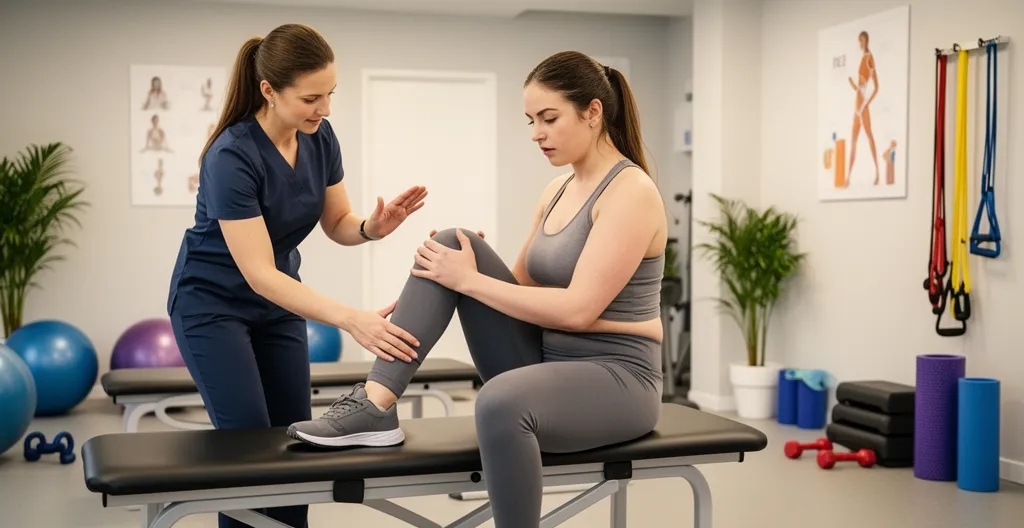
When Conservative Treatment May Be Sufficient: Early-to-moderate osteoarthritis often responds well to weight management, targeted strengthening, and activity modification. Partial ligament injuries in low-demand patients may stabilise without reconstruction. Meniscal tears in older adults frequently become asymptomatic with time. The key question is whether your current symptoms justify surgical risks—not whether imaging shows abnormalities.
A common mistake patients make is abandoning physiotherapy too early. Real results require 12-16 weeks of consistent, progressive exercise—not sporadic sessions. Many patients declaring physiotherapy “failed” completed only 4-6 weeks or attended inconsistently. This matters.
Should You Continue Conservative Treatment?
- If symptoms improving month-over-month: Continue current programme with progression
- If plateau after 3+ months genuine effort: Consider surgical consultation while maintaining exercise
- If symptoms worsening despite compliance: Urgent surgical evaluation warranted
- If unable to comply due to pain: May need intervention to enable rehabilitation
The rehabilitation principles that apply to knee conditions echo those relevant to other orthopaedic challenges. The patience and consistency required mirror what patients experience during recovery after a calcaneus fracture—structured progression over months rather than weeks.
Six months. That is the threshold NHS guidance establishes. Not arbitrary. Evidence-based. Rushing past this timeline may mean undergoing surgery that conservative treatment could have avoided.
Types of Knee Surgery and Their Specific Indications
Knee surgery encompasses procedures ranging from minimally invasive keyhole techniques to complete joint replacement. Understanding which procedure addresses which problem helps you evaluate whether a recommended intervention matches your diagnosis. Think of it as a spectrum: repair, reconstruct, or replace. Your pathology determines where you fall.
The comparison below outlines the primary surgical options, their typical indications, and what patients can expect regarding recovery and longevity. These figures represent averages from published literature. Individual results vary based on age, activity level, surgical technique, and rehabilitation compliance.
| Procedure | Typical Indication | Recovery Time | Activity Return | Longevity |
|---|---|---|---|---|
| ACL Reconstruction | Complete ligament rupture with instability | 9-12 months full recovery | Competitive sport possible | Graft typically lasts 15-20+ years |
| Total Knee Replacement | Advanced osteoarthritis, bone-on-bone | 3-6 months functional recovery | Low-impact activities | 85-90% last 20+ years |
| Partial Knee Replacement | Single-compartment arthritis | 6-12 weeks faster than total | Moderate activities including some sport | 80-85% last 15+ years |
| Arthroscopy | Meniscal tears, loose bodies, diagnostic | 2-6 weeks typical | Full return common | Procedure-dependent |
ACL Reconstruction: For Ligament Injuries
ACL reconstruction replaces a torn anterior cruciate ligament with a graft—typically harvested from your own hamstring or patellar tendon, or occasionally from a donor. The procedure aims to restore knee stability and enable return to pivoting activities that the injured knee cannot safely perform.
According to ACL reconstruction outcomes 2024 published in Physical Therapy in Sport, return-to-sport rates remain lower than many patients expect, and one-fifth of patients sustain a second ACL injury. These statistics reflect reality. They are not meant to discourage surgery where indicated but to calibrate expectations.
The best candidates for ACL reconstruction are active individuals who experience recurrent instability episodes during their desired activities. Age matters less than activity demand. A 45-year-old recreational skier may benefit more than a 25-year-old who has already transitioned to non-pivoting exercise.
Knee Replacement: Addressing Advanced Arthritis
Joint replacement becomes appropriate when arthritis has destroyed the cartilage surfaces beyond what other interventions can address. The procedure resurfaces the damaged bone with metal and plastic components, eliminating the painful bone-on-bone contact that characterises end-stage disease.
Clinical Pattern: Unicompartmental Knee Replacement
A typical presentation involves an active individual in their early forties, recreational tennis player, with progressive single-compartment osteoarthritis. After 18 months of conservative treatment including physiotherapy, injections, and activity modification, significant pain persisted. Initial reluctance due to fear of major surgery delayed intervention. Following robotic-assisted unicompartmental replacement, return to recreational sport occurred at 4 months post-surgery, with pain-free status maintained at 12-month follow-up. This outcome pattern aligns with published unicompartmental arthroplasty data. Individual results depend on patient selection and surgical precision.
The UK National Joint Registry data 2024 confirms a continued reduction in revision surgery, with evidence that implants are lasting longer and outcomes improving year-over-year. This registry has tracked over 4 million procedures since 2003. The data supports confidence in modern joint replacement when appropriately indicated.
Arthroscopy: Minimally Invasive Diagnostic and Treatment
Arthroscopy involves inserting a small camera and instruments through keyhole incisions. It serves both diagnostic and therapeutic purposes: confirming diagnoses, removing loose bodies, trimming damaged meniscal tissue, or treating specific cartilage lesions.
Not all meniscal tears require arthroscopy. Degenerative tears in older adults often become asymptomatic without intervention. Traumatic tears causing mechanical symptoms—locking, catching, giving way—are more likely to benefit from surgical treatment. The distinction matters enormously.
My strong view: arthroscopy for osteoarthritis alone, without mechanical symptoms, rarely provides lasting benefit. Multiple studies have shown it performs no better than sham surgery for generalised arthritic pain. If your surgeon recommends arthroscopy, ask specifically what mechanical problem it will address.
Making the Decision: What to Discuss With Your Surgeon
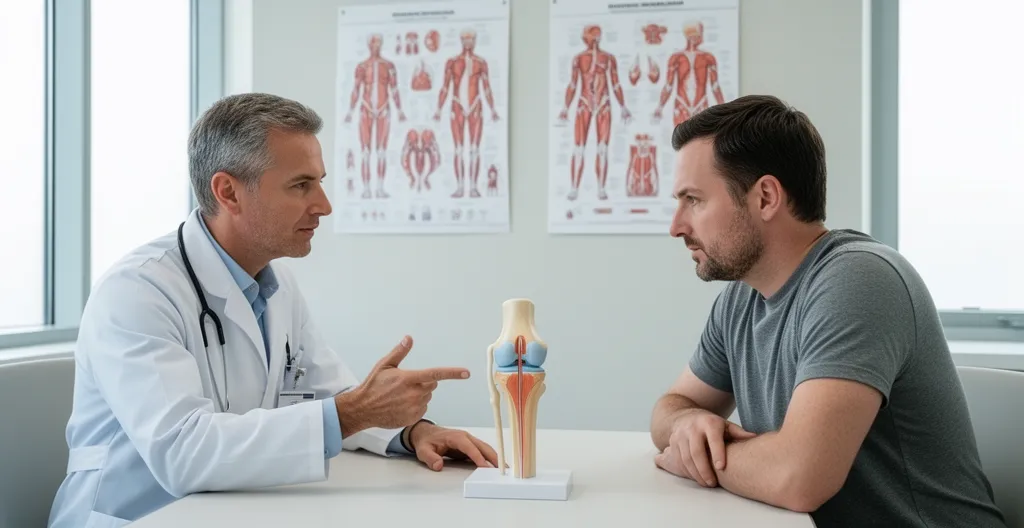
What question are you afraid to ask your surgeon? Most patients share the same unspoken concern: “Am I being offered surgery because I need it, or because that is what surgeons do?” Valid question. Addressing it requires preparation.
Arriving at your consultation with organised information transforms the interaction. You move from passive recipient to active participant. Your surgeon cannot assess factors you do not mention. Equally, you cannot evaluate their recommendation without understanding your alternatives.

- Bring imaging reports and dates of previous treatments
- List medications including supplements and anti-inflammatories
- Note specific activities you cannot perform and want to resume
- Prepare questions about non-surgical alternatives still available
- Ask about surgeon’s volume for the recommended procedure
- Request realistic timeline for return to your specific activities
- Clarify what happens if you decline surgery for now
The final point deserves emphasis. Understanding the natural history of your condition without surgery helps calibrate the decision. Some conditions worsen predictably. Others plateau. Knowing which category yours falls into changes the calculus.
- Post-operative phase: pain management, swelling control, protected movement
- Progressive weight-bearing, range of motion exercises begin
- Strengthening exercises, stationary cycling, pool-based therapy
- Sport-specific rehabilitation and functional progression
- Return to competitive activity subject to functional testing clearance
This timeline reflects standard ACL rehabilitation protocols aligned with ESSKA guidelines. Knee replacement follows a different trajectory—functional recovery typically occurs faster (3-6 months), though full adaptation may take a year. Your surgeon should provide procedure-specific expectations.
Surgical techniques continue to evolve. Robotic-assisted procedures, personalised implant positioning, and improved rehabilitation protocols represent ongoing developments. For context on how medical technology continues to advance treatment options, the emerging field of innovations in biotechnology and antibodies demonstrates the pace of change across healthcare.
Important Limitations
- This article provides general guidance and cannot replace individualised medical assessment
- Surgical indications vary based on patient age, activity level, and specific pathology
- Recovery timelines mentioned are averages and individual results may differ significantly
- Medical guidelines and surgical techniques evolve regularly
Risks to Consider:
- Delaying necessary surgery may lead to irreversible joint damage
- Proceeding with surgery when conservative treatment is sufficient carries unnecessary surgical risks
- Choosing inappropriate surgical technique may result in suboptimal outcomes
Recommended Consultation: orthopaedic surgeon specialising in knee surgery